Guide
IQ vs IQ: the three exam modes and the questions inside
Quick, Standard or Challenge? What each paper asks, the kinds of questions you will meet, and how to use Review to improve.
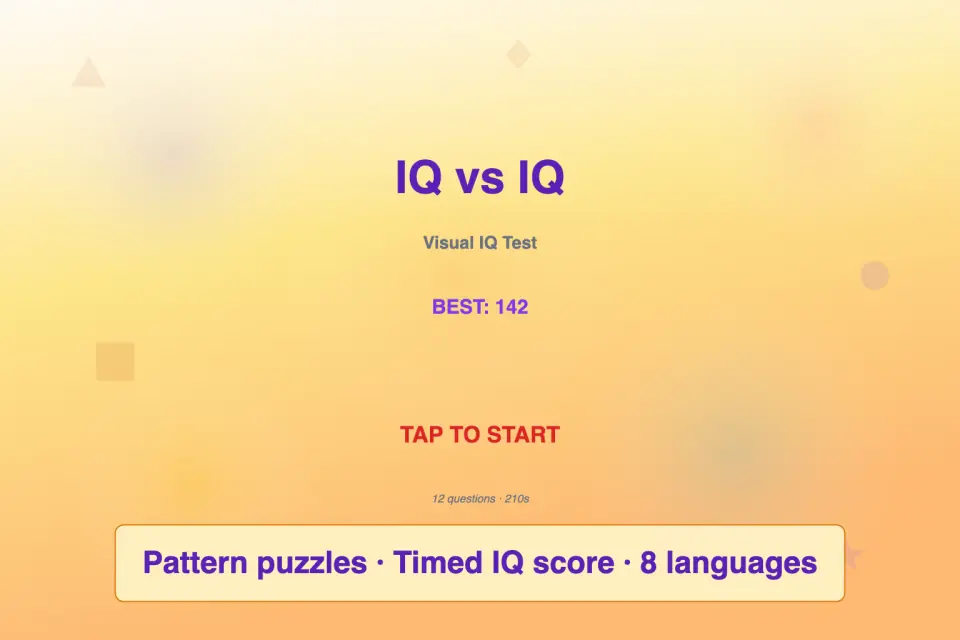
IQ vs IQ is a visual reasoning puzzle drawn like a paper exam: line-art shapes, arrows, dot grids and sequences on a warm desk. No account or setup — pick a mode and the clock starts. Play it in your browser or on Android.
One honest note first: the number at the end describes the answers you gave in one timed session and nothing more. It is a game score, not a clinical, educational or professional measurement.
Three papers, one question bank
- Quick — 8 questions in 2 minutes, about a quarter of them from the harder end.
- Standard — 12 questions in 3 minutes 30 seconds, close to half harder items.
- Challenge — 15 questions in 4 minutes, roughly seven in ten harder, with more spatial, geometric and pattern work.
What you will meet
- Number series — steady steps, growing differences, doubling chains, squares, and sequences where each term is the sum of the two before.
- Letter runs — alphabets that skip forward or count backwards.
- Geometry — sides of polygons, angles, symmetry, perimeter and area, cubes.
- Visual items — the heart of the paper: completing a series or matrix, rotations, mirror images, overlays, counting shapes in a crowded figure, and spotting the figure that breaks the rule.
- A lighter strand — clocks and calendars, compass directions, everyday science, word analogies and short logic statements.
How the exam flows
- The timer stays visible. Prev and Next let you move in any order, so skip an item and come back.
- Pause freezes the clock and keeps your place.
- Before you submit, a confirmation tells you how many questions are still blank — unanswered questions count as wrong, so a guess is never worse than a blank.
Use Review
After a paper, Review reopens it one question at a time: the right answer is marked green and your wrong pick red. Most misses fall into a few patterns — a rotation read the wrong way, a sequence read in the wrong direction, a miscount in a busy figure. Spotting yours is the fastest way to improve.
Records are kept separately for each mode on your device, and an optional leaderboard lists real players by season and all time. More on the IQ vs IQ page, or start a Quick paper.