IQ vs IQ
Visual reasoning exam
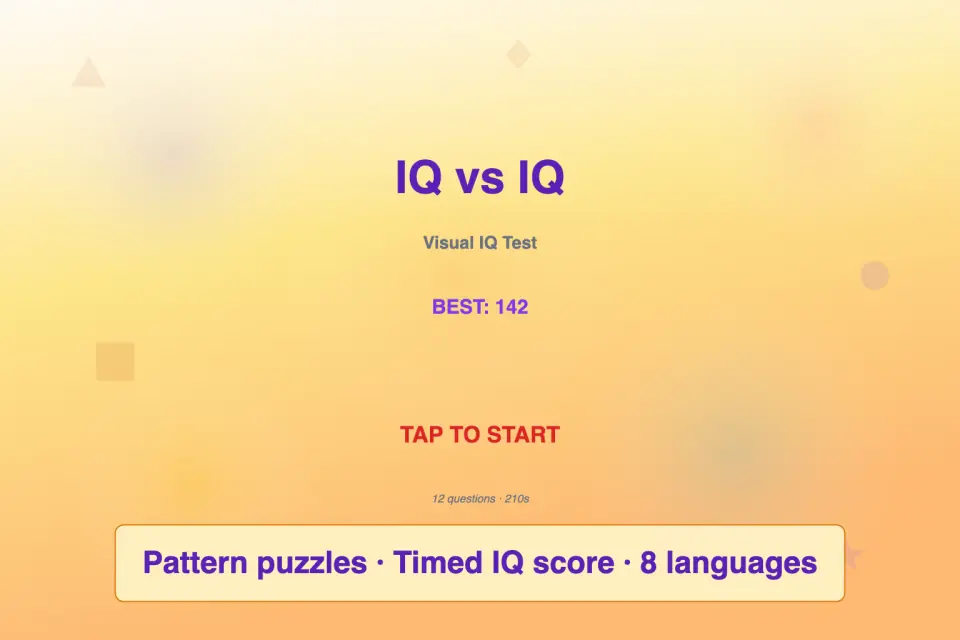
Visual reasoning in 3 timed modes with pause, review, and local records.
IQ vs IQ is a visual reasoning exam drawn on a warm paper-and-ink desk. Every question is line art on canvas: shapes, arrows, dot grids, and sequences sit on the page the way they would in a printed booklet. No account or setup is needed, so a session starts the moment you pick a mode.
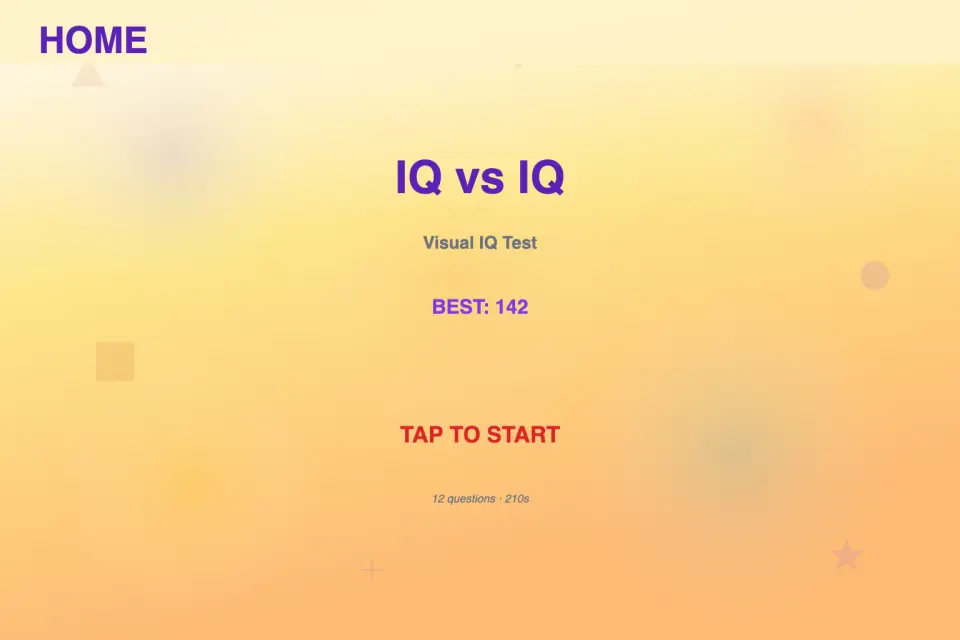
Three exam formats share one question bank at different pacing. Quick asks 8 questions in 2 minutes and keeps about a quarter of the draw on the harder end. Standard asks 12 questions in 3 minutes 30 seconds with close to half the paper taken from harder items. Challenge asks 15 questions in 4 minutes, raises the difficult share to roughly seven in ten, and leans toward spatial, geometric, and pattern work.
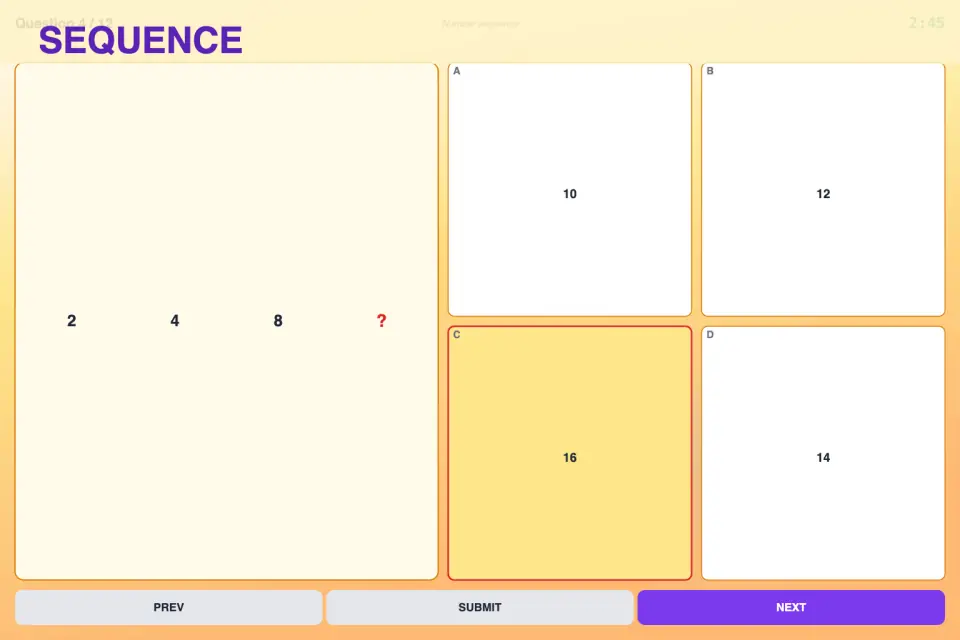
Number items cover arithmetic steps, growing differences such as +1, +3, +5, +7, doubling and tripling chains, perfect squares, Fibonacci growth like 1, 1, 2, 3, 5, and division ladders such as 81, 27, 9. Letter runs ask for the next term in alphabets that skip forward or count backwards, and short calculations cover percentages and simple averages.
Geometry asks how many sides a polygon has, what the interior angle of a square measures, how the angles of a triangle sum, which figure carries the most lines of symmetry, and what the complement of a given angle comes to. Other items move to perimeter and area, the faces and volume of a cube, radius against diameter, and how the diagonals of a square behave.
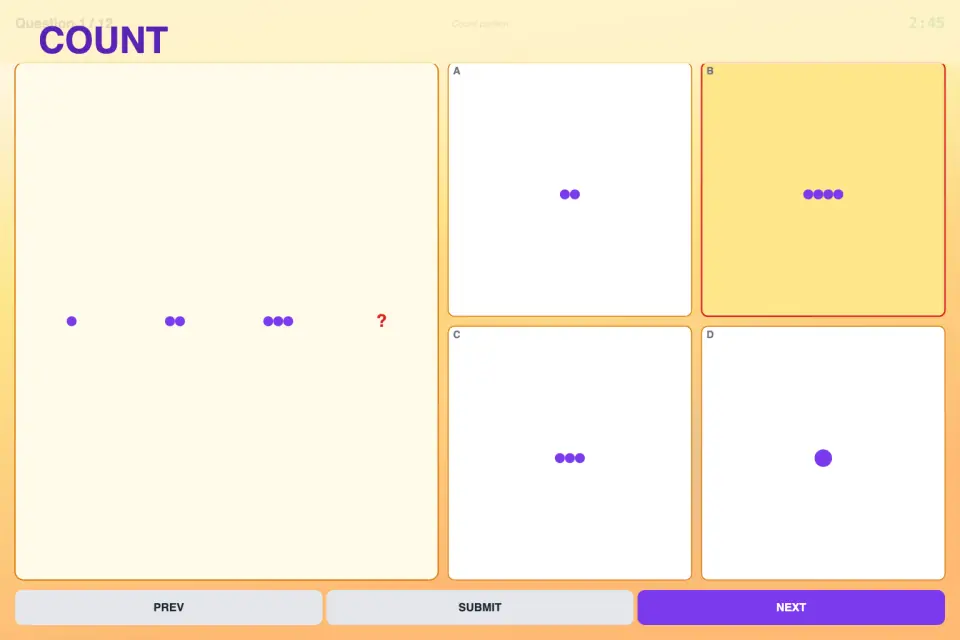
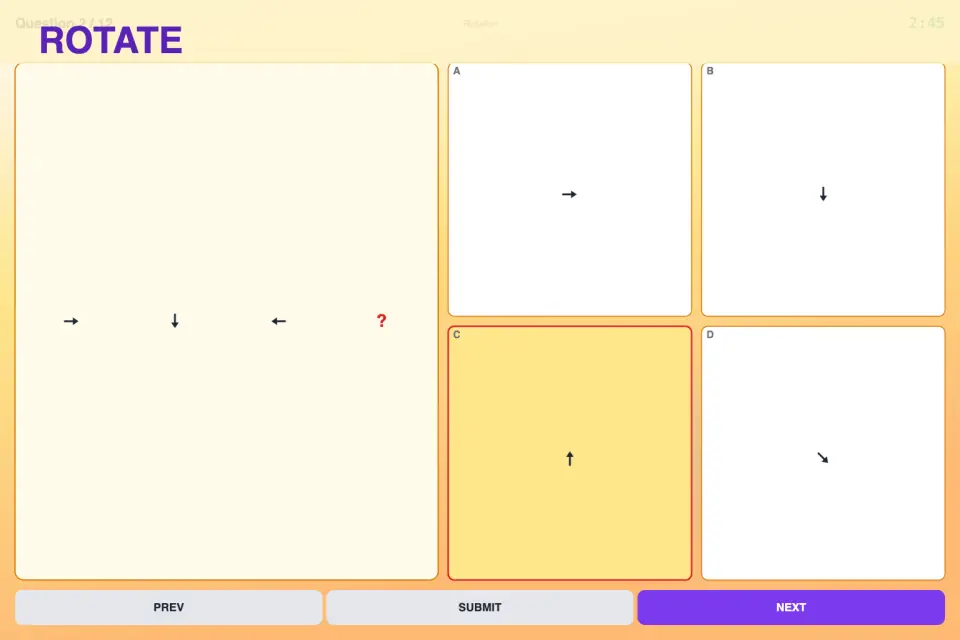
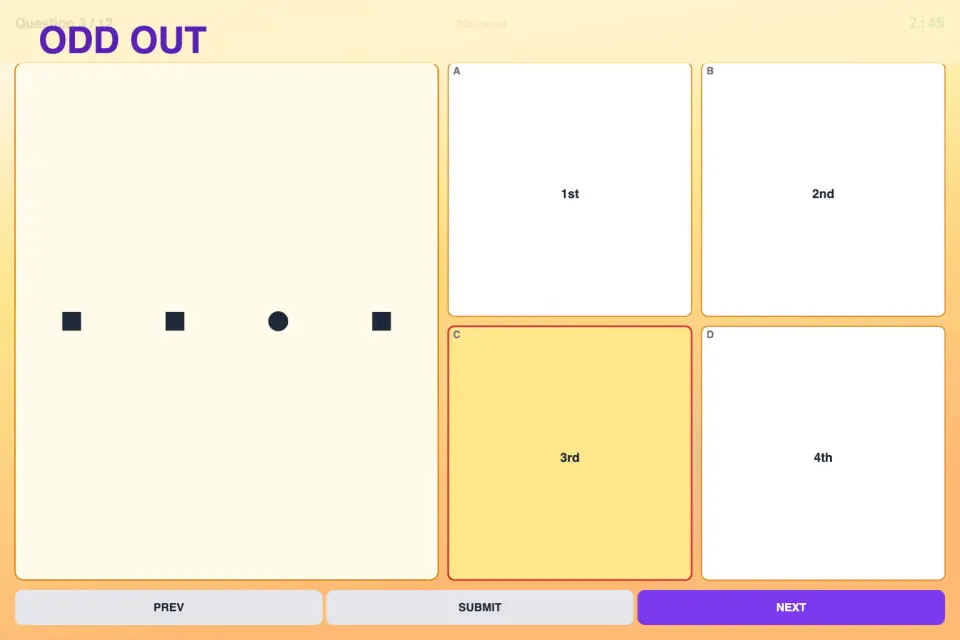
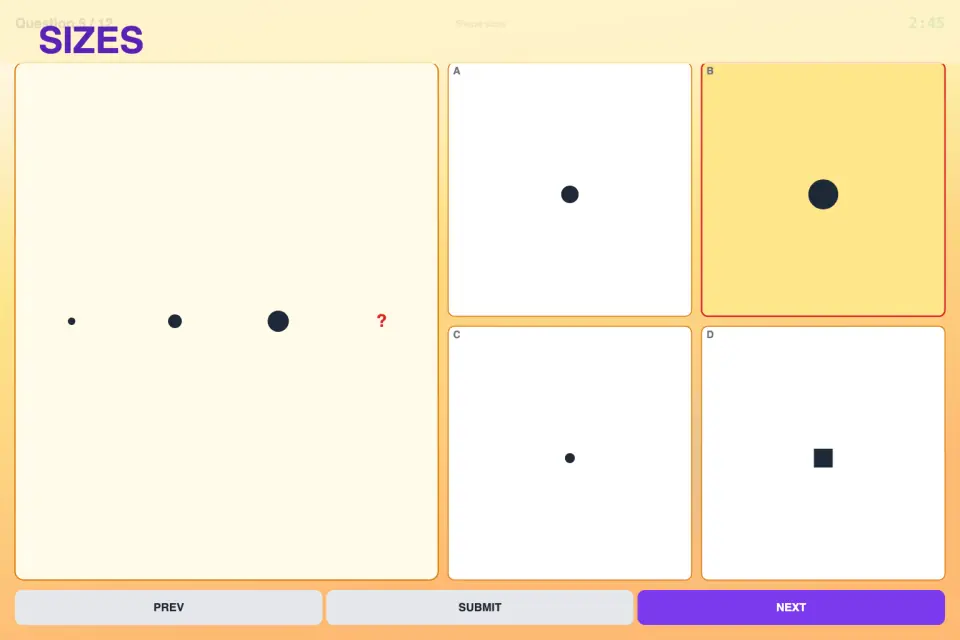
Visual items are the centre of the paper. Series and matrices ask which figure completes a progression, rotations turn a shape by 45 or 180 degrees, mirror questions flip an arrow across a vertical or horizontal line, and overlay questions combine two drawings. Counting items ask for the triangles, circles, dots, or star points inside a crowded figure, while odd-figure and analogy items ask which drawing breaks the rule.
A lighter strand keeps the exam varied: clock and calendar reasoning, seasons and compass directions, everyday science such as freezing and boiling points, and short logic statements. Word analogies pair ideas the way bird pairs with nest, and odd-one-out items mix categories.
The timer stays visible while you work. Prev and Next move through the paper in any order, so an uncertain item can be left and picked up later, and pause freezes the clock while holding your position. Submitting opens a confirmation that reports how many questions are still blank, because unanswered items score as incorrect. A finished paper returns a result from 0 to 160 with a band such as Average, Above average, Superior, or Genius.
Review reopens the completed paper one question at a time. The correct choice is marked in green and your own incorrect pick in red, so a miss can be traced to its cause: a rotation read the wrong way, a sequence direction reversed, or a miscount in a busy figure.
Progress stays on the device. Local statistics record how many exams you have finished and your personal record for Quick, Standard, and Challenge separately. An optional leaderboard shows current-season and all-time standings, filters by mode, and places your rank beside a rival near your score once a nickname is set. Sound and music have separate switches, a how-to-play card explains the rules, and the desk envelope opens a contact form.
On iPhone and iPad the desk reflows to the screen in your hands. Answer cards stay comfortably tappable, portrait and landscape are both supported, and the extra iPad space widens the figure under test instead of stretching empty margins. Sessions and records are stored on the device, and eight interface languages can be switched at any time.
IQ vs IQ is a puzzle game and an informal reasoning exercise. The number it reports describes the answers given in one timed session and nothing more; it is not a clinical, educational, or professional measurement. Used as practice, the modes are a steady way to notice patterns sooner.
Features
- Three modes: Quick, Standard, Challenge from a large Canvas 2D bank
- Timers by mode (120s / 210s / 240s) with pause that freezes the clock
- IQ score 0–160 from correct / total (formula unchanged across modes)
- Open navigation — answer in any order; unanswered count as wrong
- Review, leaderboard, contact form, and local stats per mode
- 8 language support
Tips
- Prev and Next let you answer in any order — leave a slow figure and come back to it.
- Unanswered questions count as wrong, so check the blank count on the confirmation before you submit.
- Use Review after each paper: green marks the right answer and red your pick, so you can see whether a rotation or sequence direction tripped you up.
What's new
This update makes every leaderboard fair and transparent. • Rankings now list only scores submitted by real players. Computer-controlled opponents remain for practice and challenge, but their results never appear on the board. • Changing your nickname keeps your existing scores and rank instead of starting over. • Suggested nicknames are freshly generated and are never borrowed from other players. In IQ vs IQ, the season and mode boards (Quick, Standard and Challenge) list real players only. A board with no entries now simply shows "No scores yet" so you can set the first score. Questions, timing and IQ scoring are unchanged. Thanks for playing — every score you see now comes from a real person.
Questions and answers
Is the result a real IQ score?
No. IQ vs IQ is a puzzle game. The 0–160 number only describes the answers in one timed session; it is not a clinical, educational or professional measurement.
How long is each mode?
Quick: 8 questions in 2 minutes. Standard: 12 in 3 minutes 30 seconds. Challenge: 15 in 4 minutes, with more hard items.
Can I pause?
Yes. Pause freezes the clock and keeps your place.
Screenshots
Ratings and comments
Leaderboard
Mode: Quick
Scores come straight from the game. Nicknames are chosen by players.
Play on web