Guide
Gomoku Friend: five in a row on a 15×15 board, and the threats that win games
Two players share one screen and X always starts. The exact rules this version uses, how Undo works, and the open threes and fours that decide most games.
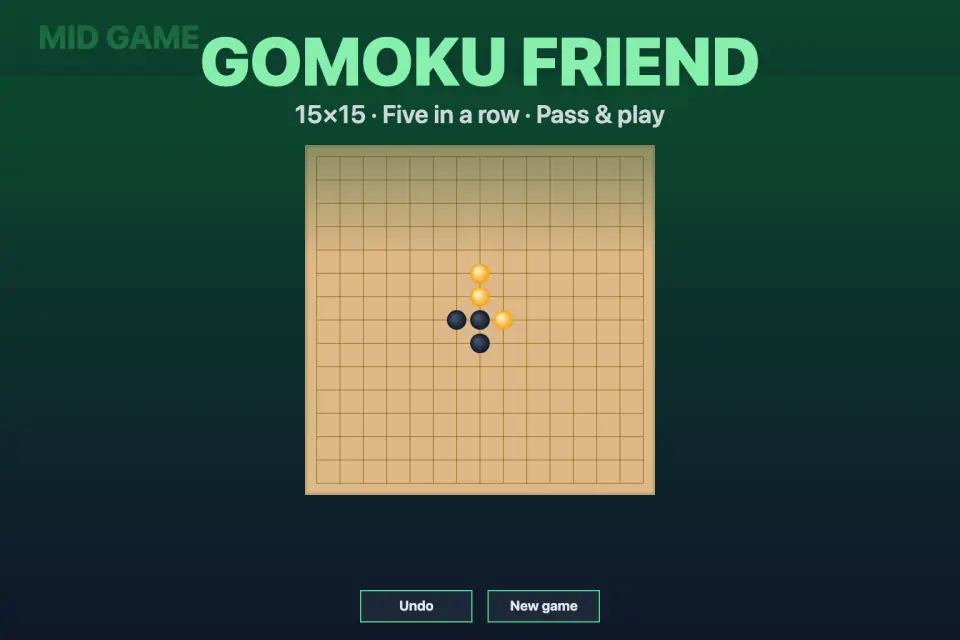
Gomoku Friend is gomoku for two people on one phone or tablet: you take turns placing pieces on the same screen, and there is no computer opponent. You can also play it in your browser.
The rules in this version
- The board has 15×15 squares, and pieces go inside the squares. X (dark pieces) always moves first, O (amber pieces) second.
- Five of your pieces in a straight line, across, down or diagonally, wins. A line of six or more also wins: there is no overline rule and no restriction on the first player, so it's the plain variant with no extra rules.
- If the board fills up with no five, the game is a draw.
- The last move is highlighted, so after passing the phone the other player can see straight away what changed. The winning five glow, with a line drawn through them.
Undo and New game
Undo takes back the last move, one move at a time, as many times as you like, even after someone has won. That's great for learning ("what if I had blocked there?"), but agree before a serious game whether take-backs are allowed. New game clears the board, and X starts again. Since X always goes first, swap who plays X from game to game.
The shapes that matter
- Four: four in a row with at least one open end. It must be blocked on the very next move, or it becomes five.
- Open four: four in a row with both ends empty. It can't be stopped, because blocking one end leaves the other. If your opponent has one, the game is already over.
- Open three: three in a row with both ends empty. Left alone, it turns into an open four on the next move, so treat it as an emergency and block one end right away.
- Broken three: a pattern like X X _ X with open ends. It's just as dangerous as a solid three and easier to overlook.
How games are actually won
Almost every game ends with a double threat: one move that makes two threats at once, such as a four plus an open three, or two open threes. Your opponent can only block one. So when you attack, look for squares where two of your lines cross. When you defend, check every line through the opponent's last move, not just the one that looks obvious.
Three simple habits
- Start near the centre. Pieces at the edge have fewer directions to grow in.
- Keep your pieces connected. Scattered stones rarely end up forming threats.
- Before each move, ask one question: "does my opponent have a three or a four anywhere?" Answer it first, then attack.
More on the Gomoku Friend page, or start a game.